
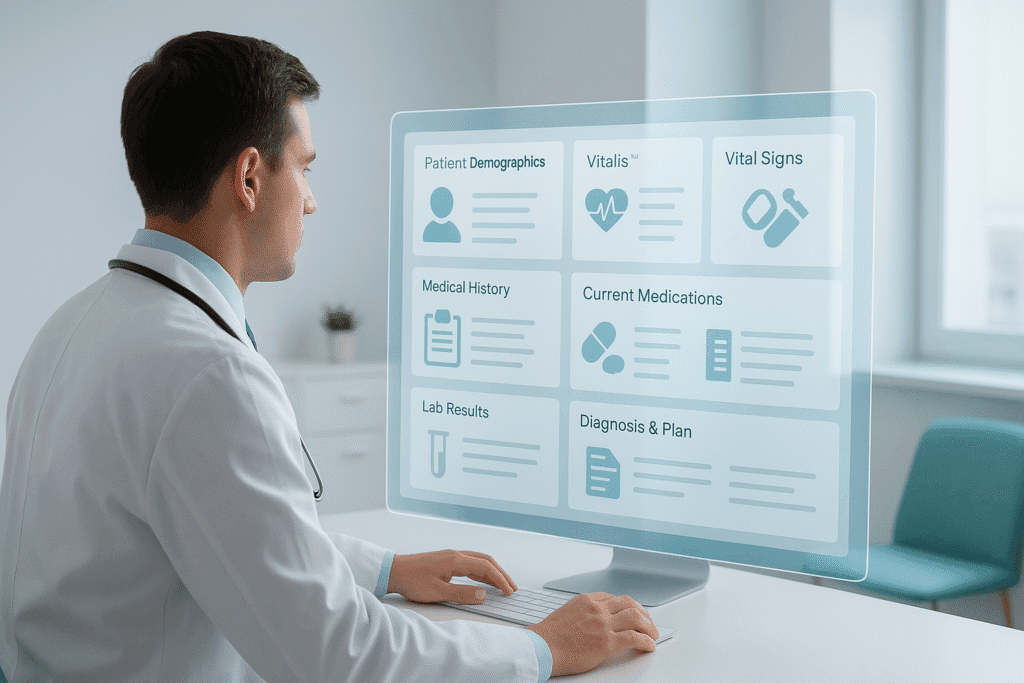
Clinical documentation templates are standardized, structured formats that guide healthcare providers in capturing complete patient information for medical records. Templates ensure consistent documentation across encounters, improve coding accuracy by 25% (AHIMA), and reduce documentation time by 30-40% (AAFP). This comprehensive guide covers templates for every specialty—from SOAP notes and H&P to ICU, surgical, behavioral health, and specialty-specific formats—with AI-powered automation strategies.
What Are Clinical Documentation Templates?
Clinical documentation templates are pre-structured frameworks that standardize how healthcare providers record patient encounters, assessments, treatment plans, and outcomes. Templates transform unstructured clinical narratives into organized, comprehensive documentation that supports accurate coding, quality reporting, legal protection, and continuity of care across the healthcare team.
How Do Clinical Documentation Templates Work?
Effective clinical documentation templates follow a systematic process to capture complete patient information:
- Template Selection: Provider selects appropriate template based on encounter type (new patient, follow-up, procedure, specialty visit).
- Pre-Population: System auto-fills known patient data—demographics, medications, allergies, problem lists—from EHR.
- Structured Data Entry: Provider documents within defined sections, ensuring all required elements are captured.
- Clinical Decision Support: Template prompts for missing elements, suggests appropriate diagnoses, and flags documentation gaps.
- Coding Optimization: Structured documentation maps to appropriate CPT, ICD-10, and E/M codes for accurate billing.
- Quality Measure Capture: Templates embed quality measure documentation (MIPS, HEDIS) to support value-based care reporting.
- Finalization: Provider reviews, signs, and submits completed documentation to patient chart.
Why Clinical Documentation Templates Matter in 2025
Documentation quality directly impacts every aspect of healthcare operations. According to MGMA, 23% of claim denials stem from documentation deficiencies—costing practices an average of $25-35 per reworked claim. Complete, structured documentation addresses this at the source.
The shift to value-based care intensifies documentation requirements. Quality measures, risk adjustment, and care coordination all depend on comprehensive clinical records. Templates ensure providers capture required elements without memorizing constantly changing requirements.
For clinicians facing burnout—63% report it according to Medscape 2024, with documentation as the leading cause—templates combined with document automation and ambient AI offer the path to sustainable practice.
Key Benefits of Clinical Templates
Documentation Completeness: Structured prompts ensure all required elements are captured. AHIMA research shows template use improves coding accuracy by 25% through complete documentation.
Time Efficiency: Pre-built structures with smart defaults reduce documentation time by 30-40% according to AAFP studies. Providers spend less time on formatting and more on patient care.
Coding Accuracy: Templates designed around E/M guidelines and specialty coding requirements support appropriate code selection, reducing denials and audit risk.
Legal Protection: Comprehensive documentation provides defensible medical records. Medical Economics research indicates structured templates reduce malpractice risk by 40%.
Care Continuity: Standardized formats enable efficient information transfer between providers, settings, and care episodes.
Core Clinical Documentation Templates
Every healthcare practice needs these foundational templates for daily operations:
SOAP Note Template
The SOAP note template remains the gold standard for outpatient documentation. The structured Subjective, Objective, Assessment, Plan format ensures logical clinical reasoning documentation that supports medical decision-making codes.
Key SOAP Elements:
- Subjective: Chief complaint, HPI, ROS, relevant history
- Objective: Vital signs, physical exam, diagnostic results
- Assessment: Diagnoses with clinical reasoning
- Plan: Treatment, medications, follow-up, patient education
History & Physical (H&P) Template
The H&P template captures comprehensive patient evaluations for new patients, hospital admissions, and pre-operative assessments. Complete H&P documentation supports higher E/M levels and surgical clearance requirements.
Progress Note Template
The progress note template documents ongoing care for established patients, hospital rounds, and chronic disease management. Structured progress notes capture interval changes, treatment response, and care plan adjustments.
Procedure Note Template
The procedure note template documents surgical and interventional procedures with required elements: indication, consent, technique, findings, complications, and post-procedure care. Complete procedure documentation supports accurate CPT coding and reduces audit risk.
Discharge Summary Template
The discharge summary template captures hospital course, discharge diagnoses, medications, and follow-up instructions. Quality discharge documentation reduces readmissions by ensuring care continuity.
Specialty-Specific Documentation Templates
Different clinical settings require specialized documentation formats that capture discipline-specific assessments and interventions:
Hospital & Acute Care Templates
ICU Note Template
Critical care documentation requires detailed system-by-system assessments, ventilator settings, hemodynamic monitoring, sedation scoring, and complex medication management. ICU templates capture the high-acuity clinical decision-making that supports critical care billing codes.
Surgical Note Template
Operative documentation must include patient positioning, anesthesia type, surgical approach, findings, specimens, blood loss, complications, and post-operative orders. Complete surgical notes support accurate procedure coding and serve as critical legal documents.
ER Note Template
Emergency department documentation captures rapid assessments, stabilization measures, and dispositions under time pressure. ED templates balance documentation completeness with clinical efficiency for high-volume, high-acuity settings.
EMS Documentation Template
Pre-hospital documentation captures scene assessment, patient condition, interventions, and transport decisions. EMS templates ensure continuity of information from field to emergency department.
Geriatric & Palliative Care Templates
Geriatric Assessment Template
Comprehensive geriatric assessments document functional status, cognitive screening, fall risk, polypharmacy review, and social determinants affecting elderly patients. These assessments support care planning and appropriate service referrals.
Palliative Care Documentation Template
Palliative templates capture symptom burden, goals of care discussions, advance directive status, and quality of life assessments. Documentation supports hospice eligibility and family communication.
End-of-Life Documentation Template
End-of-life templates document comfort measures, family presence, pronouncement, and death certificate information. Sensitive documentation during difficult moments requires structured support.
Behavioral Health Templates
ADHD Documentation Template
ADHD evaluation and management requires symptom rating scales, functional impairment documentation, medication monitoring, and controlled substance prescribing elements. Proper documentation supports diagnosis validity and prescription compliance.
RBT Session Notes Template
Registered Behavior Technician documentation captures ABA therapy sessions with behavior targets, interventions used, data collection, and supervision notes. RBT templates support BACB compliance and insurance billing.
ABA SOAP Notes Template
Applied Behavior Analysis documentation combines SOAP structure with behavior-specific elements: antecedent-behavior-consequence analysis, skill acquisition data, and behavior reduction programs.
Rehabilitation Templates
Occupational Therapy SOAP Note Template
OT documentation captures functional assessments, ADL performance, therapeutic interventions, and progress toward occupation-based goals. OT-specific templates address unique documentation requirements for rehabilitation services.
Physiotherapy SOAP Note Template
Physical therapy templates document movement assessments, pain scales, therapeutic exercises, modalities, and functional outcome measures required for PT billing and progress tracking.
Additional Specialty Templates
Dental SOAP Note Template
Dental documentation includes oral examination findings, radiographic interpretation, treatment provided, and home care instructions specific to dental and oral surgery practices.
Medical Clearance Template
Pre-operative and activity clearance documentation requires structured risk assessment, cardiovascular evaluation, medication management, and explicit clearance statements for referring providers.
Medication List Template
Medication reconciliation templates ensure accurate capture of current medications, doses, frequencies, and prescribers—critical for patient safety during transitions of care.
Clinical Template Comparison Table
| Template Type | Primary Use | Key Elements | Specialty |
|---|---|---|---|
| SOAP Note | Outpatient visits | S-O-A-P structure | All ambulatory |
| H&P | New patients, admissions | Complete history, ROS, PE | All settings |
| Progress Note | Follow-up, rounds | Interval changes, plan | All settings |
| Procedure Note | Surgeries, interventions | Technique, findings | Surgery, procedural |
| ICU Note | Critical care | System-by-system, devices | Critical care |
| ER Note | Emergency visits | Rapid assessment, MDM | Emergency medicine |
| Surgical Note | Operative documentation | Full operative report | All surgical |
| Discharge Summary | Hospital discharge | Course, instructions | Inpatient |
| Geriatric Assessment | Elderly evaluation | Functional, cognitive | Geriatrics |
| Palliative Note | Symptom management | Goals of care, comfort | Palliative/hospice |
| Behavioral Health | Mental health visits | Mental status, safety | Psychiatry, psychology |
| Therapy Notes | Rehab sessions | Functional progress | PT, OT, SLP |
AI-Powered Clinical Documentation
While templates provide structure, AI transforms how documentation is created. Healthcare automation now enables templates to be completed through ambient listening rather than manual entry.
How AI Scribe + Templates Work Together
- Template Selection: AI identifies appropriate template based on appointment type and specialty
- Ambient Capture: AI listens to patient-provider conversation during encounter
- Intelligent Mapping: Spoken content maps to correct template sections automatically
- Structured Output: AI generates complete documentation in proper template format
- Provider Review: Clinician reviews AI-generated note, makes edits, and signs
According to KLAS Research, AI documentation achieves 95-98% accuracy while reducing documentation time by 50-70%. The combination of intelligent templates with AI medical scribe technology delivers the best of both worlds: structured completeness with minimal manual effort.
Template + AI Benefits
Consistent Structure: Every note follows specialty-appropriate format regardless of which provider creates it.
Complete Capture: AI captures clinical details providers might not manually document, improving coding support.
Coding Optimization: AI-generated notes with proper templates support AI medical coding for accurate revenue capture.
Time Recovery: Physicians save 2-3 hours daily when AI handles template completion.
Template Design Best Practices
Structure for Completeness
Required vs. Optional Fields: Clearly distinguish mandatory elements from supplementary documentation. Required fields should align with E/M requirements and specialty standards.
Logical Flow: Organize sections to match clinical thinking—history before exam, assessment before plan. Natural flow reduces cognitive burden.
Smart Defaults: Pre-populate normal findings, standard orders, and common responses. Providers document exceptions rather than recreating baselines.
Optimize for Coding
E/M Alignment: Structure history, exam, and MDM sections to support medical decision-making documentation required for appropriate E/M level selection.
Diagnosis Specificity: Prompt for laterality, acuity, and manifestations that drive ICD-10 code specificity. Generic diagnoses leave revenue on the table.
Procedure Elements: Include all required elements for procedure coding: time, technique, complexity factors. Complete documentation supports appropriate reimbursement.
Support Quality Reporting
Embedded Measures: Integrate quality measure documentation (HbA1c ordered, depression screening completed, fall risk assessed) directly into relevant templates.
Structured Data: Use discrete data fields rather than free text for quality measures to enable automated reporting.
Care Gap Alerts: Configure templates to surface care gaps based on patient conditions and due preventive services.
Template Implementation Guide
Phase 1: Assessment (1-2 Weeks)
Current State Analysis: Review existing documentation practices, identify variation, and assess completion rates.
Denial Analysis: Analyze claim denials to identify documentation-related rejection patterns.
Provider Input: Gather clinician feedback on documentation pain points and workflow preferences.
Phase 2: Design (2-4 Weeks)
Template Selection: Choose or create templates aligned with specialty, encounter types, and EHR capabilities.
Customization: Adapt templates to organization-specific requirements, quality measures, and workflow preferences.
Coding Review: Have certified coders validate template elements support appropriate code selection.
Phase 3: Deployment (2-4 Weeks)
EHR Configuration: Build templates in your EHR system with appropriate triggers and favorites.
Training: Educate providers on template use, customization options, and documentation best practices.
Pilot Testing: Deploy with limited users, gather feedback, and refine before organization-wide rollout.
Phase 4: Optimization (Ongoing)
Performance Monitoring: Track documentation completion rates, denial trends, and provider satisfaction.
Continuous Improvement: Refine templates based on coding feedback, regulatory changes, and user input.
AI Integration: Evaluate AI billing and scribe solutions to automate template completion.
Common Documentation Mistakes to Avoid
Mistake: Copy-Forward Abuse
Problem: Copying previous notes without updating creates inaccurate records and audit liability.
Solution: Use copy-forward selectively for stable elements; always document current assessment and any changes.
Mistake: Template Bloat
Problem: Overly detailed templates with excessive check-boxes create documentation burden without value.
Solution: Design templates for appropriate level of detail; use macros for common scenarios rather than exhaustive options.
Mistake: Missing Medical Necessity
Problem: Documentation captures what was done without explaining why—failing medical necessity requirements.
Solution: Include fields for clinical indications, failed alternatives, and medical reasoning.
Mistake: Inconsistent Terminology
Problem: Different providers using different terms for same conditions complicates coding and continuity.
Solution: Use diagnosis pick-lists with standardized terminology mapping to ICD-10 codes.
Frequently Asked Questions
What is the most commonly used clinical documentation template?
The SOAP note template is the most widely used format across healthcare settings. Its Subjective-Objective-Assessment-Plan structure provides logical organization that works for most outpatient encounters and has become standard training in medical education.
How do templates improve coding accuracy?
Templates prompt providers to document all elements required for accurate code selection—diagnosis specificity, medical decision-making complexity, procedure details, and time. AHIMA research indicates structured templates improve coding accuracy by 25% compared to unstructured documentation.
Should templates be customized by specialty?
Yes. While core templates (SOAP, H&P) work across specialties, specialty-specific templates capture discipline-unique assessments. A cardiology template differs significantly from dermatology or behavioral health documentation needs. Use specialty templates for optimal documentation.
Can templates work with AI medical scribes?
Absolutely. AI scribes use templates as output formats, automatically populating structured sections from ambient conversation capture. This combination provides template benefits (completeness, structure) without manual entry burden. Ambient AI represents the evolution of template-based documentation.
How often should templates be updated?
Review templates annually or when significant changes occur: new E/M guidelines (like 2021 updates), quality measure modifications, specialty society recommendations, or regulatory requirements. Establish template governance with clinical and coding stakeholder input.
What’s the difference between templates and macros?
Templates provide overall documentation structure (sections, required elements). Macros are text shortcuts that insert common phrases or findings within template sections. Use templates for encounter framework; use macros for frequently repeated content within templates.
Automate Your Clinical Documentation with NoteV AI
While templates provide essential structure, manual completion still consumes hours of clinician time daily. NoteV’s AI medical scribe automatically generates complete, template-structured documentation from patient conversations—combining the benefits of standardization with the efficiency of automation.
NoteV Template Automation Benefits:
- ✅ Automatic template selection based on encounter type
- ✅ AI-generated SOAP, H&P, procedure, and specialty notes
- ✅ 70% reduction in documentation time
- ✅ 15-25% improvement in coding accuracy from complete documentation
- ✅ 30% reduction in claim denials from documentation gaps
- ✅ 3+ hours saved daily on clinical documentation
Join thousands of physicians who’ve eliminated documentation burden while improving revenue capture through complete, structured clinical notes.
Related Articles
Core Documentation Templates:
- → SOAP Note Template with Examples
- → History & Physical Template
- → Progress Note Template
- → Procedure Note Template
- → Discharge Summary Template
Specialty Templates:
- → ICU Note Template
- → Surgical Note Template
- → ER Note Template
- → Geriatric Assessment Template
- → Palliative Care Documentation Template
- → OT SOAP Note Template
- → Physiotherapy SOAP Note Template
AI Documentation & Automation:
- → AI Medical Scribe: Complete Guide
- → Document Automation in Healthcare: Complete Guide
- → Ambient AI: Future of Clinical Documentation
- → AI Medical Coding: Complete Guide
Disclaimer: This guide provides general documentation guidance. Specific template requirements vary by specialty, payer, state regulations, and organizational policies. Always consult current E/M guidelines, specialty society recommendations, and your compliance team for documentation standards.
Sources: AHIMA Documentation Guidelines, CMS E/M Documentation Guidelines (2021), AAFP Clinical Documentation Resources, MGMA Revenue Cycle Benchmarks, Medscape Physician Burnout Report (2024), KLAS AI Documentation Research.
]]>