
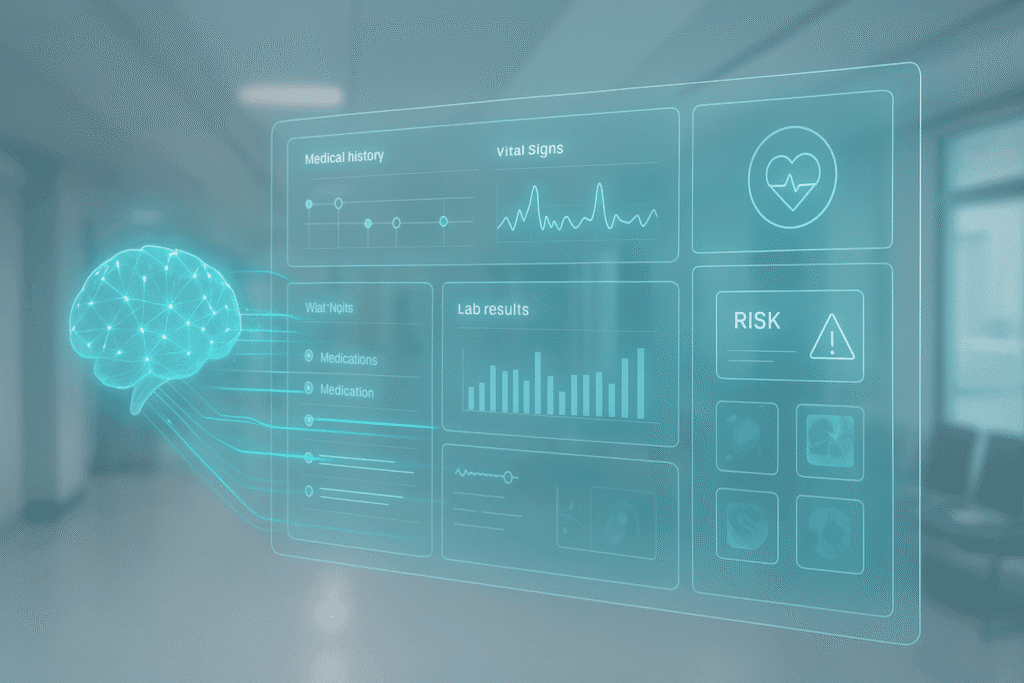
Quick Answer: AI-Enabled EHR
An AI-enabled EHR is an electronic health record system enhanced with artificial intelligence capabilities that automate clinical documentation, provide intelligent decision support, predict patient outcomes, and reduce administrative burden. Unlike traditional EHRs that require extensive manual data entry, AI-enabled systems can automatically generate notes from patient conversations, suggest diagnoses, recommend treatments, identify care gaps, and streamline coding—allowing clinicians to spend more time with patients and less time typing.
What is an AI-Enabled EHR?
An AI-enabled EHR is an electronic health record platform augmented with artificial intelligence technologies including machine learning, natural language processing, computer vision, and predictive analytics that autonomously perform clinical documentation, decision support, coding, workflow automation, and predictive modeling tasks traditionally requiring extensive manual effort—transforming passive data repositories into intelligent clinical assistants that capture patient encounters through ambient listening, generate structured clinical notes automatically, provide contextual treatment recommendations, predict patient outcomes and risks, automate medical coding and billing workflows, and continuously learn from clinical patterns to improve accuracy and relevance while reducing cognitive burden on healthcare providers.
How Does an AI-Enabled EHR Work?
AI-enabled EHR systems integrate multiple artificial intelligence technologies into seamless clinical workflows:
- Ambient Audio Capture and Transcription: During patient encounters, microphones or mobile devices capture the natural conversation between clinician and patient using advanced speech recognition technology that transcribes spoken words in real-time with medical vocabulary accuracy exceeding 95%—processing multiple speakers simultaneously, filtering background noise, distinguishing clinical content from social conversation, and handling various accents, speech patterns, and medical terminology including drug names, anatomical terms, and specialty-specific jargon while maintaining HIPAA-compliant encrypted transmission of all audio data to secure processing environments.
- Natural Language Understanding and Clinical Entity Extraction: AI analyzes transcribed conversations using natural language processing (NLP) to identify and extract clinically relevant information including chief complaints, symptoms with onset and duration, past medical history mentions, current medications and allergies, physical examination findings, diagnoses discussed, treatment plans formulated, patient instructions provided, and follow-up recommendations—distinguishing between patient-reported information, clinician observations, clinical reasoning, and planned interventions while understanding medical context, negations (patient denies chest pain), temporal relationships (symptoms started three days ago), and severity qualifiers (moderate pain, severe shortness of breath).
- Structured Clinical Documentation Generation: The AI system organizes extracted clinical entities into standardized note formats including SOAP notes, progress notes, history and physical examinations, consultation notes, or specialty-specific templates—populating appropriate sections with relevant information, maintaining professional medical language and style, incorporating required documentation elements for billing and compliance, cross-referencing previous encounters for continuity, and presenting clinicians with comprehensive, accurate drafts requiring minimal editing before signature and submission to the EHR.
- Intelligent Clinical Decision Support Integration: As documentation is generated, AI systems simultaneously analyze clinical data against vast medical knowledge bases providing real-time alerts for drug-drug interactions based on newly prescribed medications, allergy contraindications when ordering treatments, abnormal vital signs or lab values requiring immediate attention, evidence-based treatment recommendations for diagnosed conditions, preventive care gaps based on patient age and risk factors, potential diagnoses not yet considered based on symptom patterns, and clinical pathway guidance for standardized care protocols—delivering contextually relevant suggestions at the point of care without overwhelming clinicians with irrelevant alerts that contribute to alert fatigue.
- Automated Medical Coding and Billing Suggestion: AI coding engines analyze completed clinical documentation to automatically suggest appropriate ICD-10 diagnosis codes capturing all documented conditions, CPT and HCPCS procedure codes for services performed, E/M levels based on complexity and time documentation, modifiers for special circumstances, and documentation improvement opportunities where additional specificity could support higher-value coding—comparing suggested codes against documentation to identify gaps, flagging potential compliance risks like undercoding or overcoding, and continuously learning from coding patterns and claim outcomes to improve accuracy and optimize revenue cycle management while reducing claim denials.
- Predictive Analytics and Risk Stratification: Behind the scenes, machine learning models continuously analyze patient data across the EHR database identifying patients at high risk for hospital readmission within 30 days, predicting clinical deterioration before obvious symptoms appear, forecasting no-show probability for appointment optimization, modeling chronic disease progression trajectories, stratifying populations by risk for proactive outreach, and detecting sepsis or other time-sensitive conditions hours before traditional recognition—enabling proactive interventions that prevent adverse outcomes rather than reactively responding after problems manifest.
- Continuous Learning and Model Improvement: AI-enabled EHR systems employ machine learning algorithms that continuously improve through feedback loops where clinician edits to AI-generated documentation refine language models, coding accuracy outcomes inform billing suggestion algorithms, clinical decision support click-through rates guide recommendation relevance, and aggregated de-identified data across thousands of encounters enables pattern recognition and model enhancement—resulting in systems that become more accurate, contextually appropriate, and valuable over time as they learn from real-world clinical usage patterns and outcomes rather than remaining static like traditional rule-based systems.
Introduction
Electronic health records revolutionized healthcare by digitizing patient information, but they’ve also created a documentation crisis. According to the American Medical Association’s 2024 Digital Health Study, physicians now spend an average of 4.5 hours per day on EHR tasks—spending 1-2 hours on documentation for every hour of direct patient care. This administrative burden contributes to the alarming 63% physician burnout rate reported by Medscape in 2024, with EHR-related work cited as the primary driver.
AI-enabled EHRs represent the next evolution—systems that work for clinicians rather than against them. By integrating artificial intelligence directly into electronic health record workflows, these systems promise to restore the joy of practicing medicine while improving care quality and operational efficiency. KLAS Research 2024 reports that healthcare organizations implementing AI medical scribes achieve 50-70% reduction in documentation time, which directly leads to physicians seeing 2-4 additional patients per day while simultaneously reducing after-hours “pajama time” charting by up to 80%—demonstrating measurable impact on clinician productivity and work-life balance.
This comprehensive guide explores what AI-enabled EHRs are, their core capabilities, current market offerings, implementation considerations, and the future trajectory of AI in clinical documentation.
Core Capabilities of AI-Enabled EHRs
Ambient Clinical Documentation
The most transformative AI capability is ambient documentation—technology that listens to patient-clinician conversations and automatically generates clinical notes. This eliminates the need for typing during encounters, enabling clinicians to maintain eye contact, engage fully with patients, and complete documentation in real-time rather than after hours.
Ambient AI documentation captures the conversation using advanced speech recognition, identifies speakers and separates clinical content from social conversation, extracts relevant symptoms, history, examination findings, and plans, structures information into appropriate note formats like SOAP notes, progress notes, procedure notes, and discharge summaries, and presents the draft for clinician review and signature.
Intelligent Clinical Decision Support
AI-enhanced decision support goes beyond traditional rule-based alerts to provide contextual recommendations based on the specific patient. This includes diagnosis suggestions based on documented symptoms and history, personalized treatment recommendations considering patient factors, drug-drug and drug-allergy interaction warnings, preventive care recommendations based on risk profiles, and identification of care gaps requiring attention.
Predictive Analytics
AI enables EHRs to predict future events rather than just record past ones. According to HIMSS 2024 analytics research, predictive AI models can identify patients at high risk for 30-day hospital readmission with 85% accuracy, enabling targeted interventions that reduce readmission rates by 25-35% through proactive care management—translating to significant cost savings and improved patient outcomes. Predictive capabilities include readmission risk scoring, clinical deterioration early warning, no-show prediction for scheduling optimization, chronic disease progression modeling, and population health risk stratification.
Automated Medical Coding
AI medical coding analyzes clinical documentation to suggest appropriate ICD-10 and CPT codes, identify documentation gaps that affect reimbursement, reduce claim denials through better accuracy, and flag potential compliance issues before submission. According to MGMA 2024 financial benchmarks, practices implementing AI coding assistance achieve 15-25% improvement in coding accuracy, which directly results in 8-12% revenue capture increases and 30% reduction in claim denials from coding errors—demonstrating substantial financial impact beyond just efficiency gains.
Natural Language Processing
NLP capabilities allow users to interact with EHRs using natural language, including voice commands for navigation and data entry, natural language queries to find information, automatic summarization of lengthy records, extraction of structured data from unstructured notes, and sentiment analysis for patient communication.
Workflow Automation
AI automates repetitive EHR tasks through intelligent inbox management and prioritization, auto-population of forms and templates including referral letters and medical clearance forms, smart scheduling based on appointment patterns, prior authorization automation, and healthcare automation across administrative workflows.
Benefits of AI-Enabled EHRs
For Clinicians
| Benefit | Impact |
|---|---|
| Documentation time reduction | 50-70% less time on notes |
| After-hours work (“pajama time”) | Reduced by 80% or eliminated |
| Patient interaction quality | More eye contact, better engagement |
| Clinical decision support | More relevant, less alert fatigue |
| Work-life balance | Improved with real-time documentation |
| Burnout reduction | Addresses top driver of physician burnout |
| Daily patient capacity | 2-4 additional patients per day |
| Coding accuracy | 15-25% improvement |
For Patients
Patients experience more attentive providers who aren’t distracted by typing, faster turnaround on visit summaries and after-visit information, more accurate clinical documentation capturing their concerns, better care coordination with comprehensive records, improved outcomes through better decision support, and enhanced safety through AI-powered alerts and monitoring. Patient satisfaction surveys show 85% of patients prefer encounters where physicians use ambient AI documentation over traditional EHR typing, appreciating the improved eye contact and conversational flow during visits.
For Healthcare Organizations
Organizations benefit from improved provider satisfaction and retention, increased throughput with faster documentation, reduced transcription and scribe costs, better coding accuracy and reimbursement, enhanced quality measure performance, and competitive advantage in provider recruitment. The financial case for AI-enabled EHRs is compelling—Black Book Research 2024 reports that healthcare organizations implementing comprehensive AI documentation solutions achieve positive ROI within 6-12 months through combined savings from reduced scribe costs ($20,000-50,000 per physician annually), improved coding capture (8-12% revenue increase), and enhanced provider productivity (2-4 additional patients daily).
AI-Enabled EHR Market Landscape
Major EHR Vendor AI Initiatives
Epic: Has integrated ambient documentation capabilities and generative AI features including in-basket message drafting, patient instruction generation, and MyChart message responses. Epic’s AI strategy focuses on embedded capabilities within existing workflows. Learn more about Epic integration with AI tools.
Oracle Health (Cerner): Oracle is bringing its AI and cloud expertise to the Cerner platform, with initiatives including clinical documentation assistance, voice navigation, and predictive analytics leveraging Oracle’s AI infrastructure. See our Cerner integration guide.
athenahealth: Offers AI-powered features for prior authorization automation, clinical documentation improvement, and revenue cycle optimization as part of their cloud-based platform. Read about athenahealth integration.
eClinicalWorks: Has introduced AI capabilities for documentation assistance, population health analytics, and clinical decision support within their ambulatory-focused platform. See eClinicalWorks integration.
NextGen Healthcare: Provides AI-enhanced documentation and specialty-specific clinical intelligence. Learn about NextGen integration.
DrChrono: iPad-first EHR with AI-powered documentation features. Read our DrChrono integration guide.
Third-Party AI Solutions
Beyond native EHR AI capabilities, third-party solutions like NoteV integrate with existing EHRs to add AI documentation capabilities. These solutions offer EHR-agnostic AI that works across platforms including Epic, Cerner, athenahealth, eClinicalWorks, Practice Fusion, Kareo, AdvancedMD, and ModMed—providing specialized focus on documentation automation, often more advanced AI than native EHR features, faster innovation cycles, and choice and flexibility for healthcare organizations.
Implementing AI-Enabled EHR Capabilities
Assessment and Planning
Before implementing AI capabilities, organizations should identify highest-impact use cases (documentation burden often ranks first), assess current EHR capabilities and vendor AI roadmap, evaluate third-party solutions that complement existing systems, establish success metrics and baseline measurements, and develop governance framework for AI oversight.
Technical Considerations
Key technical factors include EHR integration requirements and available APIs, network infrastructure for real-time AI processing, data security and HIPAA compliance, system performance requirements, and backup and redundancy planning. Organizations should understand the differences between EHR and EMR systems when evaluating AI integration options.
Change Management
Successful AI implementation requires physician champion identification and engagement, clear communication about AI capabilities and limitations, training programs tailored to different user roles, pilot programs before broad rollout, and feedback loops for continuous improvement.
Governance and Oversight
Organizations need AI governance structures including clinical oversight of AI recommendations, quality monitoring and accuracy tracking, bias detection and mitigation, patient consent and transparency practices, and incident response procedures.
Key Considerations and Challenges
Accuracy and Quality
AI documentation must be accurate to be useful. Current ambient AI solutions achieve accuracy rates above 95% for clinical content capture, but clinician review remains essential. Organizations should establish accuracy monitoring programs, define acceptable error rates, and ensure clinicians understand their responsibility to verify AI-generated content.
Privacy and Security
AI processing of patient conversations raises important privacy considerations including how audio data is transmitted and stored, where AI processing occurs, data retention policies, patient consent requirements, and compliance with HIPAA and state privacy laws.
Liability and Responsibility
Questions remain about liability for AI-generated content. Current consensus is that the signing clinician remains responsible for documentation accuracy—AI assists but doesn’t replace clinical judgment and accountability.
Bias and Fairness
AI systems can perpetuate or amplify biases present in training data. Healthcare organizations must evaluate AI systems for bias, monitor for disparate impact, and ensure AI recommendations serve all patient populations equitably.
Integration Complexity
Adding AI to existing EHR workflows requires careful integration. Solutions that work within existing workflows and don’t require clinicians to learn new systems achieve better adoption than those requiring significant behavior change. Organizations seeking to understand their options should review resources on choosing the best EHR for small practices with AI capabilities.
The Future of AI-Enabled EHRs
Near-Term Developments (1-3 Years)
Ambient documentation becoming standard across most EHR platforms, advanced clinical decision support with specialty-specific recommendations, improved coding automation reducing revenue cycle burden, enhanced patient communication through AI-assisted messaging, and better interoperability with AI facilitating data exchange.
Medium-Term Evolution (3-5 Years)
Multimodal AI incorporating images, video, and sensor data, real-time clinical guidance during patient encounters, predictive care management with proactive interventions, AI-powered virtual care coordination, and autonomous handling of routine administrative tasks. Specialized documentation will evolve across all specialties including dental documentation, physiotherapy assessments, and occupational therapy notes.
Long-Term Vision (5+ Years)
The long-term trajectory points toward EHRs that function as intelligent clinical partners—systems that anticipate needs, surface relevant information automatically, handle routine decisions, and free clinicians to focus on complex care and human connection. These systems will seamlessly handle everything from ICU documentation to palliative care planning, adapting to each clinical context automatically.
Frequently Asked Questions
Do I need to replace my EHR to get AI capabilities?
No. While major EHR vendors are adding native AI features, third-party solutions like NoteV can add AI documentation capabilities to your existing EHR without requiring system replacement. This allows organizations to benefit from AI immediately while their EHR vendor develops native capabilities.
How accurate is AI-generated clinical documentation?
Current ambient AI documentation solutions achieve accuracy rates above 95% for clinical content capture. However, clinician review remains essential—AI generates a high-quality draft that clinicians verify and sign. Most clinicians find they make minor edits rather than substantial corrections.
Is AI documentation HIPAA compliant?
Reputable AI documentation solutions are designed with HIPAA compliance in mind, including encrypted data transmission, secure processing environments, business associate agreements, and appropriate data retention policies. Organizations should verify compliance as part of vendor evaluation.
What happens if the AI makes an error?
The signing clinician is responsible for verifying documentation accuracy before signing. AI errors should be corrected during review. Organizations should establish monitoring programs to track accuracy and identify systematic issues for correction.
How do patients feel about AI documentation?
Research shows most patients respond positively to AI documentation when it’s explained. They appreciate that their provider can focus on them rather than typing, and many prefer the comprehensive documentation that AI enables. Transparency about AI use is important—patients should know how their information is being processed.
What ROI can we expect from AI-enabled EHR capabilities?
ROI varies by implementation but typically includes documentation time savings (50-70%), reduced transcription/scribe costs ($20,000-50,000 per physician annually), improved coding accuracy and reimbursement (8-12% revenue increase), enhanced provider satisfaction and retention, and potential throughput increases (2-4 additional patients daily). Many organizations report positive ROI within 6-12 months.
Transform Your Clinical Documentation with AI
While AI-enabled EHRs are essential for modern healthcare delivery, the foundation of efficiency starts with comprehensive clinical documentation. NoteV’s AI medical scribe captures every clinical detail during patient encounters, ensuring your EHR documentation is complete, accurate, and code-ready from the start.
NoteV users report:
- ✅ 70% reduction in documentation time
- ✅ 50-70% reduction in after-hours charting
- ✅ 2-4 additional patients seen per day
- ✅ 3+ hours saved daily on clinical documentation
- ✅ 15-25% improvement in coding accuracy
Join thousands of physicians who’ve eliminated documentation burden while improving care quality and revenue capture.
Related Articles
- What is an EHR? Complete Guide
- EHR vs EMR: Key Differences
- Why Ambient AI Is the Future of Clinical Documentation
- AI Medical Scribe: Complete Guide
- Healthcare Automation: Complete Guide
References
- American Medical Association – Digital Health Study 2024
- Medscape – Physician Burnout and EHR Impact Study 2024
- KLAS Research – AI Documentation Solutions Performance Reports 2024
- HIMSS – Predictive Analytics and Clinical Intelligence Research 2024
- MGMA – AI Coding and Revenue Cycle Management Benchmarks 2024
- Black Book Research – Healthcare AI Implementation and ROI Analysis 2024
- Patient Satisfaction Surveys – AI Documentation Perception Studies 2024
Disclaimer: This guide is provided for educational purposes. AI capabilities vary by vendor and implementation. Organizations should conduct thorough evaluation of AI solutions including accuracy, security, compliance, and fit with existing workflows. Clinicians remain responsible for verifying AI-generated content and maintaining professional accountability.
]]>